Trip.com Hotel Booking Overview
Trip.com is worth considering as part of an accommodation search if you want to explore a broad provider-described hotel network and have access to support outside normal office hours. Whether it suits your trip depends on the particular property, room and booking conditions you choose. Its public information provides a starting point for that decision, but does not establish how an individual reservation will work out.
This review examines Trip.com’s own descriptions of its travel services and customer support for UK independent travellers. It draws on excerpts from the company’s About Us page and Service Guarantee page. It is a source-based assessment, with no hands-on booking test or independent measurement of service performance.
Trip.com describes itself as an international travel service provider offering accommodation alongside other travel services. It also advertises multilingual customer support available around the clock. Those characteristics may be useful when planning travel across destinations or time zones, although neither tells you whether a specific hotel meets your needs.
The practical decision has three parts: does the accommodation suit your itinerary, are the offer’s payment and cancellation conditions acceptable, and do you understand how to seek help if something changes? Use the platform description to decide whether to explore further, then assess the actual offer. The evidence here does not support a blanket recommendation based on price, hotel quality or guaranteed problem resolution.
Hotel Booking Features and Potential Strengths
On its About Us page, Trip.com reports a network of more than 1.7 million hotels. It also says its service is available in 24 languages, across 39 countries and regions, and in 35 local currencies. These are provider-reported figures rather than independently audited findings in this review. Source: Trip.com About Us.
For a traveller comparing destinations, the potential benefit of a large network is having a substantial pool of accommodation to investigate. The useful question is whether it contains suitable options for your particular stay. A worldwide total does not establish availability for your dates, the number of appropriate rooms in a neighbourhood, or the quality of any listed property.
Trip.com’s public information also presents a wider travel offering, including flights, trains, car rentals, airport transfers, and attractions and tours. If your itinerary involves several travel arrangements, that breadth may make the service relevant to your planning. The supplied material does not establish that arranging several services together produces a saving, shares cancellation conditions or simplifies the handling of a problem.
Multilingual provision and round-the-clock support are further potential strengths. Access outside UK office hours may matter when you are travelling elsewhere or need help with an upcoming stay. However, the general multilingual description does not specify which language is available through each contact route at a particular time.
Start with accommodation requirements: location, room suitability, occupancy and the facilities you need. Treat platform breadth as a reason to search, then compare the properties and terms that actually fit those requirements. Network size alone is a weak basis for choosing where to sleep.
Limitations and Terms That Need Checking
The available evidence consists of corporate information and an excerpt from a service policy. These sources explain what Trip.com says it offers, but provide no comparative booking exercise, hotel inspection, customer satisfaction study or measured support outcomes. They therefore cannot establish that Trip.com offers the lowest prices, consistently good accommodation or a particular speed of resolution.
This distinction matters when deciding how much weight to give a feature. A large accommodation network does not establish the suitability of a room. A contact service described as available 24/7 does not establish how quickly an agent will answer or how long a property will take to respond. Neither source supplies a reliable basis for predicting your individual experience.
The service language also needs careful reading. Statements about doing its best, coordinating a stay and trying to arrange a room describe assistance efforts. They do not, by themselves, establish that a preferred replacement will be secured. Advance compensation has an explicit condition: Trip.com says it investigates complaints and provides compensation in advance if its fault is verified. Source: Trip.com Service Guarantee.
The supplied hotel policy excerpt ends partway through the description of alternative accommodation assistance. That prevents a complete assessment of its scope or conditions. Read the full current policy before relying on that assistance for a booking decision.
Finally, neither excerpt establishes the cancellation eligibility, payment schedule, inclusions or total payable amount for a particular reservation. Check these against the exact offer you intend to purchase. If a detail would change your decision, obtain clarification from the provider before confirming rather than assuming a general support statement answers it.
Customer Support and Hotel Booking Problems
AI-generated generic editorial illustration — not a retailer product photo and does not depict the reviewed product or service.
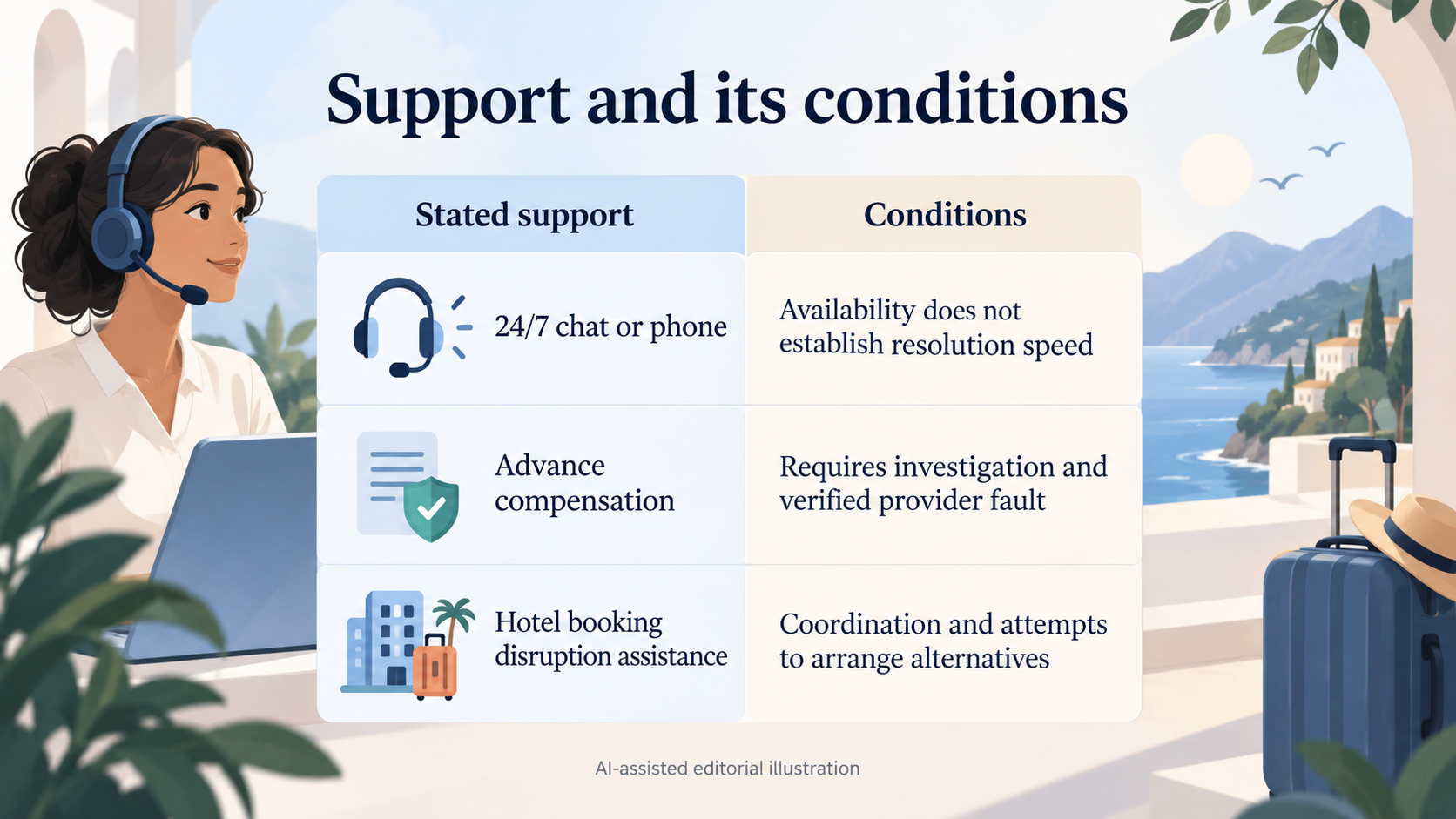 Trip.com’s Service Guarantee page advertises customer support available 24/7 through chat or phone. This identifies the stated contact channels and availability; it supplies no measured response time, resolution deadline or success rate. Before travelling, locate the current support route relevant to your booking and keep your confirmation accessible. Source: Trip.com Service Guarantee.
For a confirmed accommodation booking that changes, Trip.com says it will do its best to coordinate the stay. The supplied excerpt addresses a specific situation: after confirmation but before arrival, the property can no longer arrange check-in. Trip.com says it will immediately notify the traveller and work with the property to try to arrange a room of the same or a higher standard than the room originally booked.
The wording supports an expectation of notification and an attempt to resolve the room problem with the property. It does not establish that a suitable replacement room will always be available, or that a replacement will preserve every feature that mattered to you, such as layout or location within the building.
The excerpt then begins discussing help with another stay if no room type can be arranged at the original property, but stops before completing that explanation. Consult the full current accommodation policy for the remaining provisions. The fragment is insufficient to specify the alternative property, costs or other conditions.
Advance compensation is described separately as a policy across Trip.com’s businesses. The stated sequence is investigation, verification that Trip.com is at fault, and compensation in advance. It should not be read as automatic eligibility whenever a hotel booking causes inconvenience.
If a problem arises, explain the booking details, what the property has communicated and which arrangements remain unresolved. Ask support to clarify the proposed next step and any associated conditions before agreeing to a change.
What to Check Before Confirming Your Stay
AI-generated generic editorial illustration — not a retailer product photo and does not depict the reviewed product or service.
 Use the following checklist for the specific accommodation offer you are considering. These are traveller verification steps, rather than a description of confirmed Trip.com interface features. They help turn a broad search into a decision about a particular room and set of conditions.
Confirm the property and location. Check the full property name and address against your intended destination. Consider the journeys you expect to make from it. If you have found similarly named properties, make sure every comparison refers to the same one.
Match the room to your party. Verify the room category, bed arrangement and permitted occupancy. Check any facilities or accessibility details that are essential to your stay with the provider. A general description of the hotel is insufficient to resolve a question about the exact room you intend to book.
Recheck dates and guests. Confirm arrival and departure dates, the number of nights and the guest details. If your travel plans involve a late arrival, ask about the arrangements relevant to that arrival time before paying.
Review the total payable amount and inclusions. Establish the currency, what the quoted total covers and whether any amounts are payable separately. Check whether meals or other services you want are included. Do not infer the final cost from a headline amount alone.
Read payment and cancellation conditions. Identify when payment is due and what the offer says about cancellation, amendments and failure to arrive. Where a deadline applies, check the stated date, time and time zone. Resolve unclear wording with the provider before confirming.
Retain the confirmation and support details. Keep a copy of the confirmed room, dates, price and conditions. Locate the current customer support route so you can refer to the reservation if you need assistance.
When comparing Trip.com with another platform or a direct booking, use the same property, dates, occupancy, room category and inclusions. Compare the total cost alongside payment and cancellation conditions. If those details differ, recognise that you are evaluating different offers; the lower headline amount alone does not settle which one suits you.
Check hotel options and booking terms
Frequently Asked Questions
How can I contact Trip.com if I need help with a hotel booking?
Trip.com’s Service Guarantee page says customer support is available 24/7 via chat or phone. Use the provider’s current support information to find the appropriate contact route, and have your booking confirmation ready to explain the reservation and the issue. The supplied excerpt does not identify a UK-specific telephone number or establish waiting times. Its multilingual support description also does not confirm language availability for every channel at every moment. Source: Trip.com Service Guarantee.
What does Trip.com say it will do if my confirmed hotel cannot accommodate me?
For a property that cannot arrange check-in after confirmation but before arrival, Trip.com says it will immediately notify you and work with the property to try to arrange a room of the same or a higher standard. The excerpt begins describing further accommodation assistance but is incomplete. Check the full current policy and ask support to explain the arrangements proposed for your case. The stated effort to arrange a room does not establish a guaranteed replacement outcome. Source: Trip.com Service Guarantee.
Can I cancel my Trip.com hotel booking without a charge?
The supplied evidence cannot determine this for an individual reservation. Review the cancellation conditions attached to your exact offer or confirmation, including any stated deadline and charge. If you are considering a change, clarify its effect before proceeding. General statements about customer assistance or compensation do not establish that your room can be cancelled without a charge. Contact the provider if the booking information does not clearly answer your question.
Does the available evidence show that Trip.com is cheaper than booking directly?
No. The supplied corporate and service-guarantee excerpts contain no equivalent-offer price comparison. To assess your own options, compare the same property, dates, room category, occupancy and inclusions, then check the total payable amount and payment and cancellation conditions. A price difference may accompany a difference in terms. Choose on the basis of the complete offer you can verify, rather than assuming either Trip.com or the property’s direct channel is always cheaper.
Related reading
- How to choose a hotel booking website for your trip
- How to compare hotel rooms, locations and guest reviews
- When to book a hotel: comparing dates and flexible options
- How to compare hotel deals without overlooking the total cost
Editorial information: About our editorial team · Read our editorial policy · Read our affiliate disclosure.