Start with your trip requirements
Choose a hotel booking website by checking how well its actual offers fit your trip. Begin with your dates, preferred location, party size, accessibility requirements, budget and need for flexibility. These give you a consistent basis for comparing results across websites.
Write down your non-negotiables before searching. For location, identify the places you need to reach and check the property's address against them. For your travelling party, record the number of adults and children, the required sleeping arrangements and any room features you need confirmed.
If accessibility is essential, describe the specific facilities or arrangements you require. Ask the property or booking provider to confirm them for the exact accommodation you are considering, and retain that confirmation.
Set a budget for the whole stay and decide how much uncertainty remains in your plans. If your dates could change, make cancellation and amendment conditions part of your initial shortlist.
Use those requirements to narrow your options before comparing website features. The goal is a reservation that fits your circumstances, with a cost and set of conditions you understand.
Match platform strengths to your planning style
Consider how you prefer to organise travel. Do you want to search for several trip components in one place, or concentrate on accommodation after arranging the rest of your journey? Use that preference to decide which browsing tools deserve your attention.
Expedia Group describes Expedia as an all-in-one travel platform covering flights, holiday rentals, hotels, cars and cruises. On the same page, it presents Hotels.com with a hotel-focused message that emphasises finding suitable stays, rewards and booking management. These are the company's descriptions of its brands. They provide examples of different platform positioning, without establishing which will deliver the best reservation for your trip. Expedia Group's travel brands
If you want to organise several parts of a journey together, explore whether a broader platform makes your planning easier. Check how clearly it presents each component and its conditions before choosing it for convenience. If your transport is already arranged, assess how easily an accommodation search lets you identify a suitable location, room and rate.
Still deciding between a hotel and a holiday rental? Settle the practical requirements first: the space you need, sleeping arrangements and facilities you expect to use. Then apply the same requirements to your searches.
Treat brand positioning as a starting point for your shortlist. Keep the final choice tied to the accommodation and terms available for your actual dates.
Understand the limits of platform promises
Official platform descriptions explain how providers present their services. They do not establish which website has the lowest price, the most suitable room or the best service for a particular booking. The descriptions referenced here therefore support a comparison framework, rather than a ranking of booking websites.
For example, Expedia Group's Hotels.com description promotes rewards and flexibility. Before giving either feature weight, inspect the current programme rules and the conditions of the rate you intend to reserve. Check whether any reward applies to that booking, what you would need to do to receive it and how you could use it. Do not assume that general flexibility language describes every available rate. Expedia Group's travel brands
Likewise, separate the availability of assistance from the outcome of a request. Trip.com's service page describes customer support and efforts to assist with cancellation in specified circumstances. That wording does not establish an unconditional entitlement to cancel or receive a refund. Trip.com's service guarantee
When a promotional feature matters to your decision, turn it into a concrete question: does this apply to my reservation, and where are the applicable conditions? If the answer remains unclear, ask the provider before paying. Give greater weight to clear booking-specific information than to a broad promise that leaves your needs unresolved.
Compare the complete offer
AI-generated generic editorial illustration — not a retailer product photo and does not depict the reviewed product or service.
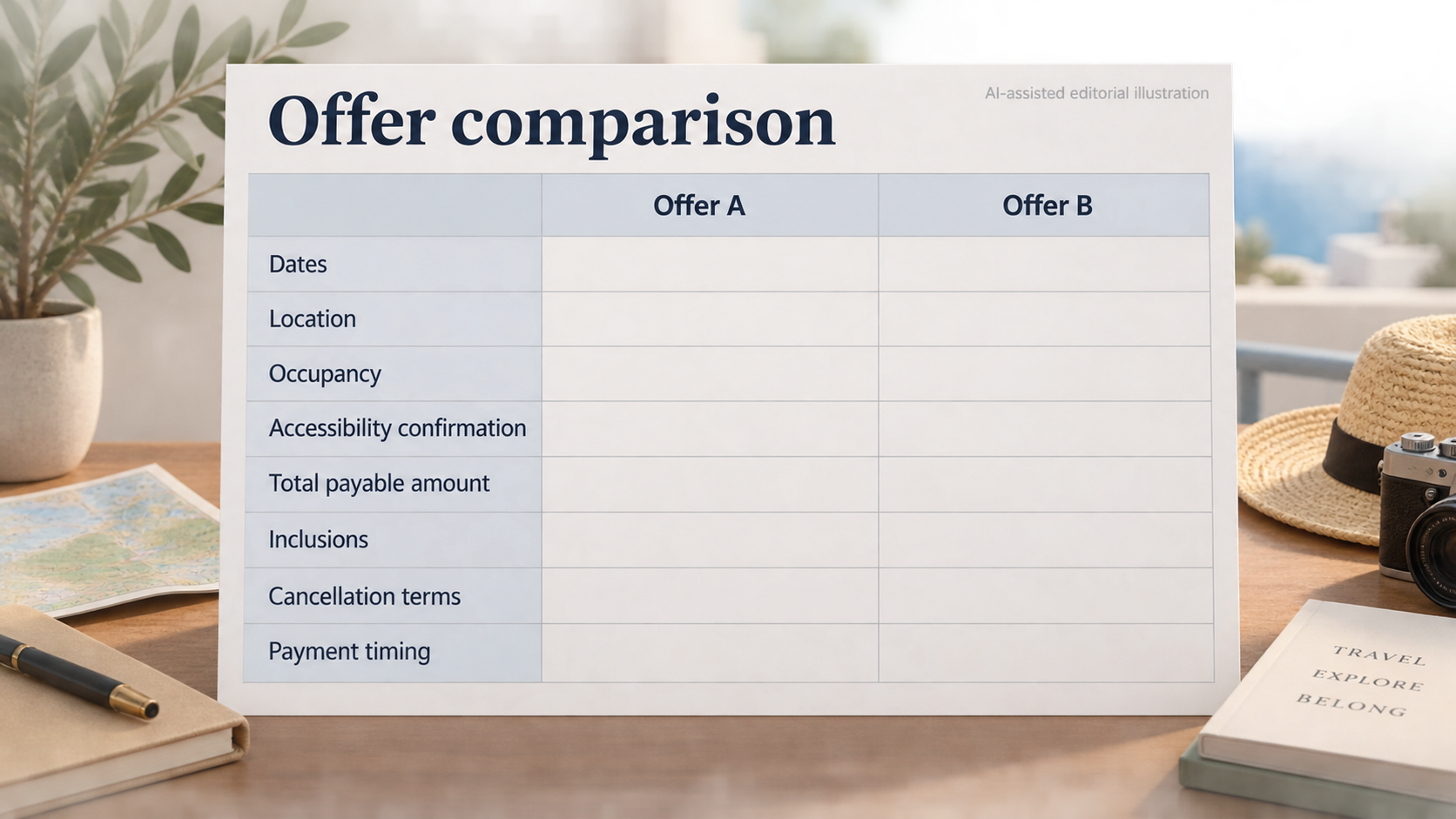 Build your comparison around the exact accommodation you would reserve. Start with matching dates, number of nights, party composition and property address. Then compare the room description, bedding, occupancy and any features that are essential to your stay.
Do not rely on a similar room name alone. Read the detail attached to each offer and ask for clarification where a difference could affect your trip. For an accessibility requirement, record what has been confirmed and by whom, rather than treating a general property description as confirmation for your room.
Next, record the complete payable amount in the stated currency. Check what the displayed total includes and whether any further amounts are listed as payable separately. If currencies differ, resolve how you will compare them before deciding that one offer costs less; avoid treating unlike totals as equivalent.
Use this worksheet with details copied from your shortlisted reservations. Leave unresolved fields blank until you have checked them.
| Detail to verify | Offer A | Offer B |
|---|---|---|
| Dates and number of nights | ||
| Property and location | ||
| Party size and permitted occupancy | ||
| Room type and bedding | ||
| Accessibility confirmation | ||
| Total payable amount and currency | ||
| Amounts payable separately | ||
| Included meals, facilities or extras | ||
| Cancellation and amendment terms | ||
| Payment timing |
Compare inclusions according to what you will actually use. Check whether an included meal covers everyone in your party, for example, and whether any facility central to your plans has relevant access conditions.
Finally, consider cost alongside flexibility. If two offers differ in cancellation conditions or payment timing, record that difference explicitly. Choose only after you can explain what each offer includes, what you would pay and which conditions you are accepting.
Check cancellation and payment conditions
Read the conditions attached to the selected rate before proceeding to payment. Record the cancellation deadline exactly as shown, including its applicable time zone. If the time zone is missing or ambiguous, ask the provider to clarify it instead of assuming it matches your own.
Check what happens both before and after that deadline. Look for any stated cancellation charge, the process for submitting a request and the conditions for changing dates, guest details or room arrangements. If you expect to amend the trip, seek a clear answer about the change you are likely to need.
Trip.com's published cancellation-assistance wording says it will make every effort to help negotiate cancellation in specified circumstances. This illustrates why an assistance process should be read carefully: an effort to negotiate does not itself confirm that a particular reservation can be cancelled without cost. Consult the current provider terms and your booking conditions for the applicable process. Trip.com's service guarantee
Review payment separately. Identify when payment is due, who is named as collecting it and any amounts stated as payable at the property. For a refundable offer, check the stated refund process and any published timing.
Before paying, make sure you know whom to contact about cancellation, amendments and payment questions. Save the conditions alongside your confirmation so you can refer to the terms you selected.
Assess support before you book
Assess support in terms of practical access. Check the provider's contact methods, how to retrieve your booking and what information you would need if a problem arose on arrival. Consider whether you could access those channels while travelling.
Trip.com states on its official service page that customer support is available 24/7 through chat or phone. This is a statement about support availability; it does not establish response speed or a guaranteed resolution for your reservation. Trip.com's service guarantee
The page also describes its approach when a property can no longer arrange check-in after confirmation but before arrival. Trip.com says it will notify the traveller immediately and work with the property to try to arrange a room of the same or a higher standard. Its broader wording says it will do its best to coordinate the stay. Treat those as the provider's stated process and best-effort commitments, rather than a confirmed outcome for every case. Trip.com's service guarantee
For any shortlisted website, check the procedure for a property being unable to accommodate you. Save the booking reference, provider contact route and property's contact details somewhere you can retrieve them easily. Resolve unclear instructions before departure, especially if you expect to arrive late.
Make your final choice with a booking checklist
AI-generated generic editorial illustration — not a retailer product photo and does not depict the reviewed product or service.
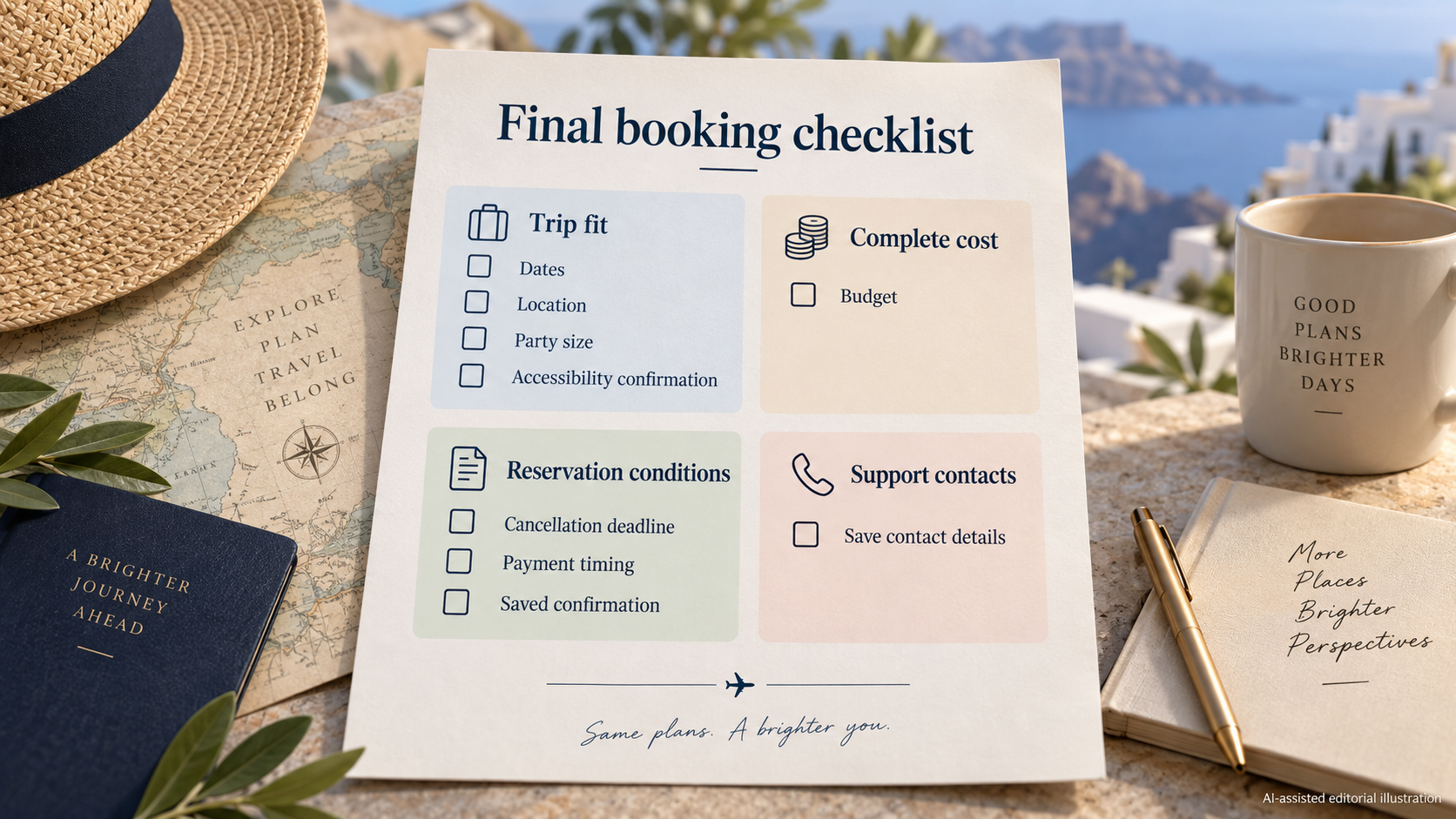 Review the reservation you are about to confirm against your original requirements. If you have changed dates, occupancy or room selection during your search, check the resulting total and conditions again.
Use this final checklist to bring the decision together:
| Area | Final checks |
|---|---|
| Trip fit | Confirm dates, location, party size, room and bedding. Obtain confirmation of essential accessibility requirements. |
| Complete cost | Confirm the total, currency, inclusions and separately payable amounts. Check the stay fits your budget. |
| Reservation conditions | Record the cancellation deadline and time zone, amendment conditions, payment timing and stated refund process. |
| Support contacts | Save the provider and property contact details. Check how to access the booking and report an arrival problem. |
| Booking record | Save the confirmation and the conditions attached to the selected reservation. |
If a material detail is unresolved, seek clarification before confirming. An unanswered question about room suitability or cancellation can change which offer fits your trip.
Choose the website whose actual reservation meets your requirements at a cost you accept, with conditions you understand and a support process you can access.
Frequently Asked Questions
Should I compare a booking website with the hotel's own website?
Yes, include the hotel's own offer if you want another option to assess. Apply the same checks to both: dates, occupancy, room specification, total payable amount, inclusions, cancellation and payment timing. Do not assume that booking directly or using an intermediary automatically gives a price or service advantage. Identify the booking contact for each offer and ask about any material difference before deciding.
How do I check whether two hotel offers are genuinely comparable?
Match the property, dates, number of nights and travelling party first. Then compare the room, bedding, essential facilities and confirmed accessibility arrangements. Record the complete cost and inclusions alongside cancellation, amendment and payment conditions. Where an important detail differs, make that difference visible in your comparison. If a description is unclear, ask the provider rather than filling the gap with an assumption.
Does 24/7 customer support guarantee a refund if my plans change?
No. Support availability does not itself establish a refund entitlement. Trip.com's page states that chat and phone support are available 24/7 and separately describes efforts to assist with cancellation in specified circumstances. Check your selected rate's cancellation conditions and the provider's current process to understand what applies to your request. Trip.com's service guarantee
Should rewards influence which hotel booking website I choose?
Consider rewards after checking trip fit, the complete cost and reservation conditions. Expedia Group promotes rewards in its Hotels.com description, but that description alone does not establish eligibility or value for your booking. Read the current programme terms, including how rewards are earned and used, before letting them affect your choice. Keep any uncertain benefit separate from the amount you must pay. Expedia Group's travel brands
Related reading
- How to compare hotel rooms, locations and guest reviews
- When to book a hotel: comparing dates and flexible options
- How to compare hotel deals without overlooking the total cost
- Best hotel booking websites: evidence-led choices for different trips
Editorial information: About our editorial team · Read our editorial policy · Read our affiliate disclosure.