When to book a hotel: start with your dates and flexibility
The most useful time to book a hotel is when you have found a stay that fits your dates, budget and tolerance for change. Start by comparing the total accommodation cost and the conditions attached to each rate. Then consider whether adjusting your dates would improve the cost of the whole trip.
There is no universally cheapest booking day or lead time established by the sources used for this guide. Treat the steps below as an editorial comparison method, rather than a prediction about future prices. Waiting for an assumed bargain gives you no confirmed outcome to work with.
Trip.com describes itself as an international travel service provider with an extensive hotel network on its official About Us page. That makes it one place to explore accommodation; its description does not establish that it lists every property or offers the lowest price for your trip.
Before searching, write down your preferred dates, any acceptable alternatives, the number of guests and your accommodation budget. Decide which requirements are essential: location, room layout, meals or the ability to cancel before a particular point. These become your comparison criteria. A lower headline price is only useful if the resulting booking still meets them.
Compare nearby dates using the whole-stay cost
AI-generated generic editorial illustration — not a retailer product photo and does not depict the reviewed product or service.
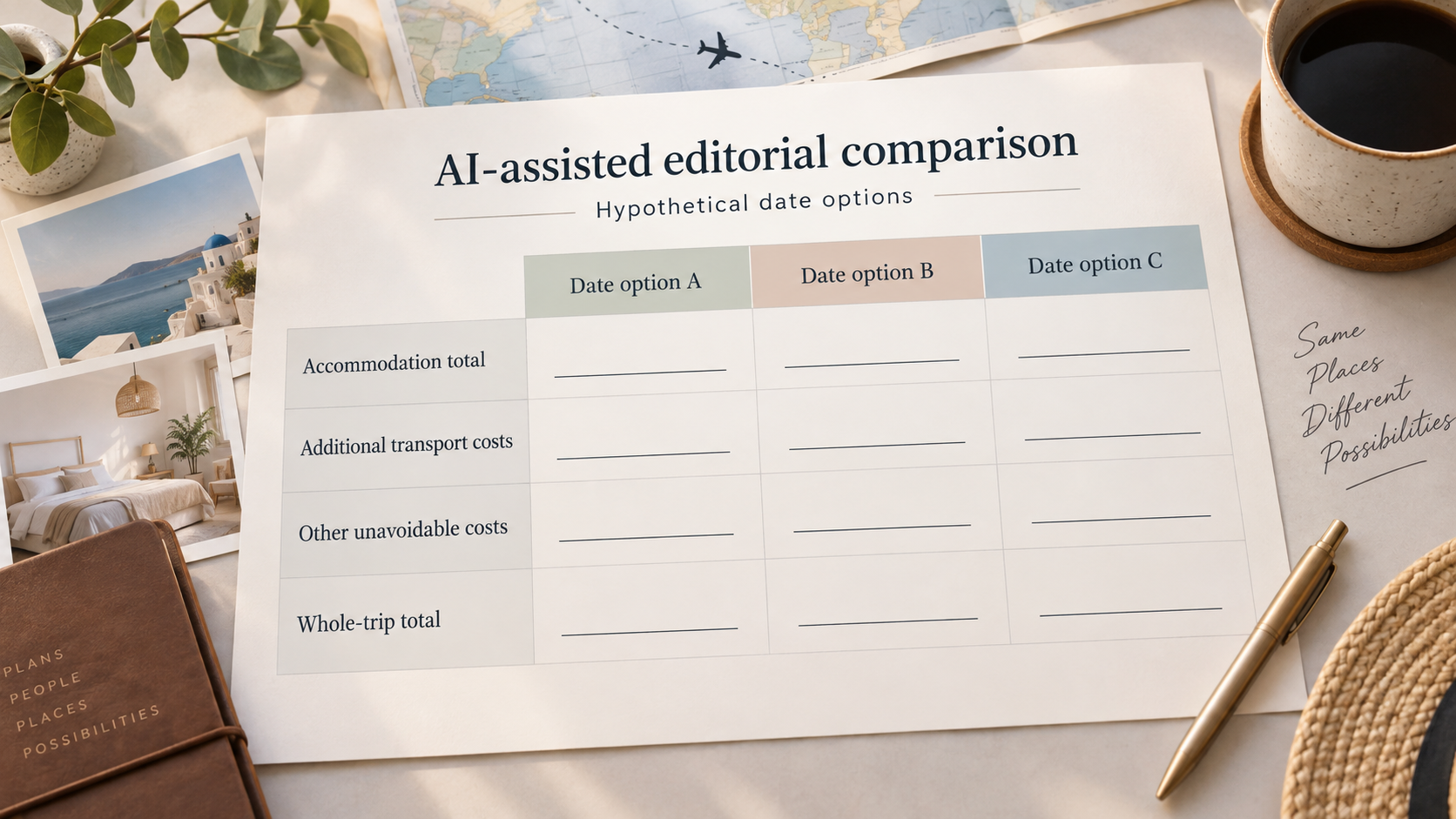 If your itinerary allows it, compare your preferred dates with two nearby alternatives. Keep the number of nights and guests consistent wherever possible. If an alternative changes the length of the trip, make that difference explicit before judging its value.
For each option, choose accommodation you would actually accept. Compare the same property and room category where practical; otherwise, record differences in location, sleeping arrangements and inclusions. Comparing a room-only rate with a breakfast-inclusive rate requires deciding whether you would use, and otherwise pay for, the breakfast.
Use this worksheet to collect your own quotes. The alternatives are hypothetical comparison options, and the blank fields are for your findings.
| What to record | Preferred dates | Nearby option A | Nearby option B |
|---|---|---|---|
| Arrival, departure and number of nights | ___ | ___ | ___ |
| Property, room and guests | ___ | ___ | ___ |
| Accommodation total, including identified mandatory charges | ___ | ___ | ___ |
| Transport cost before date-change additions | ___ | ___ | ___ |
| Additional transport costs caused by changing dates | ___ | ___ | ___ |
| Other unavoidable trip costs | ___ | ___ | ___ |
| Whole-trip total | ___ | ___ | ___ |
| Cancellation deadline and charges | ___ | ___ | ___ |
| Payment schedule | ___ | ___ | ___ |
Keep the cost rows separate so that you do not count a charge twice. If a compulsory amount is unclear, mark the total as incomplete and seek clarification.
Moving a stay might mean changing a train ticket, arranging another transfer or paying for an extra night elsewhere. Include those consequences before treating a lower accommodation quote as a saving. Also consider whether the alternative uses more annual leave or creates an inconvenient arrival.
Record when you checked each quote and use a consistent currency. Before choosing, refresh the shortlisted options together and confirm that their room details, inclusions and conditions remain comparable.
Where flexible hotel options can help
A flexible rate is worth considering when the changes it permits match a realistic uncertainty in your plans. Begin with what might change and when you expect to know, then check whether the selected rate accommodates that situation.
Suppose you are waiting for a travel companion to confirm their availability. If a rate explicitly permits cancellation without a charge until after that confirmation is expected, it may suit your planning needs. If its deadline falls before you expect an answer, it leaves the central uncertainty unresolved.
Alternatively, your destination may be certain while your arrival date remains unsettled. In that case, investigate amendment conditions as well as cancellation conditions. Do not assume that permission to cancel also means permission to move the booking at the same price. Ask how a revised stay would be priced and whether any change charge would apply.
Compare the quoted cost of the flexible option with the other suitable rate. If there is a price difference, consider whether paying it is acceptable for the specific change rights offered. You do not need to predict the likelihood of cancellation precisely; you do need to understand what you would be paying for.
Only include flexibility that is stated for the individual rate. If the wording leaves your likely scenario unclear, seek a booking-specific answer before relying on it.
Check the limits of flexibility and service guarantees
Read the full conditions behind any flexibility label before deciding that a rate suits you. Look for the exact cancellation deadline, its time zone, the stated charge after that deadline and any separate conditions for amendments or failing to arrive. Record unresolved details instead of filling gaps with assumptions.
Compare the deadline with your own planning timeline. A cancellation cut-off is useful only if it gives you enough time to act on the information you are waiting for. Set a reminder with time to spare, and retain the wording attached to the rate you select.
Trip.com's Customer Service Guarantee states that it will make every effort to assist users in negotiating cancellation in specified special circumstances. The supplied wording also sets a supporting-document deadline for the circumstances it describes. This is an offer of assistance with negotiation; it should not be treated as confirmation that your booking qualifies for a refund.
If you need to use that assistance, ask Trip.com about the current requirements, applicable deadlines and handling of your particular reservation. Avoid assuming that a general service commitment changes the cancellation charges attached to your chosen rate.
Keep three questions separate: what the rate permits, what assistance the provider offers and what outcome has actually been confirmed for your booking. A support conversation may help clarify the first two, but you still need a clear answer about the requested cancellation or amendment.
If the terms appear inconsistent between the room selection and final reservation screen, resolve the discrepancy before payment. Save the clarification alongside the booking conditions so you can refer to both later.
Decide whether to book now or keep comparing
AI-generated generic editorial illustration — not a retailer product photo and does not depict the reviewed product or service.
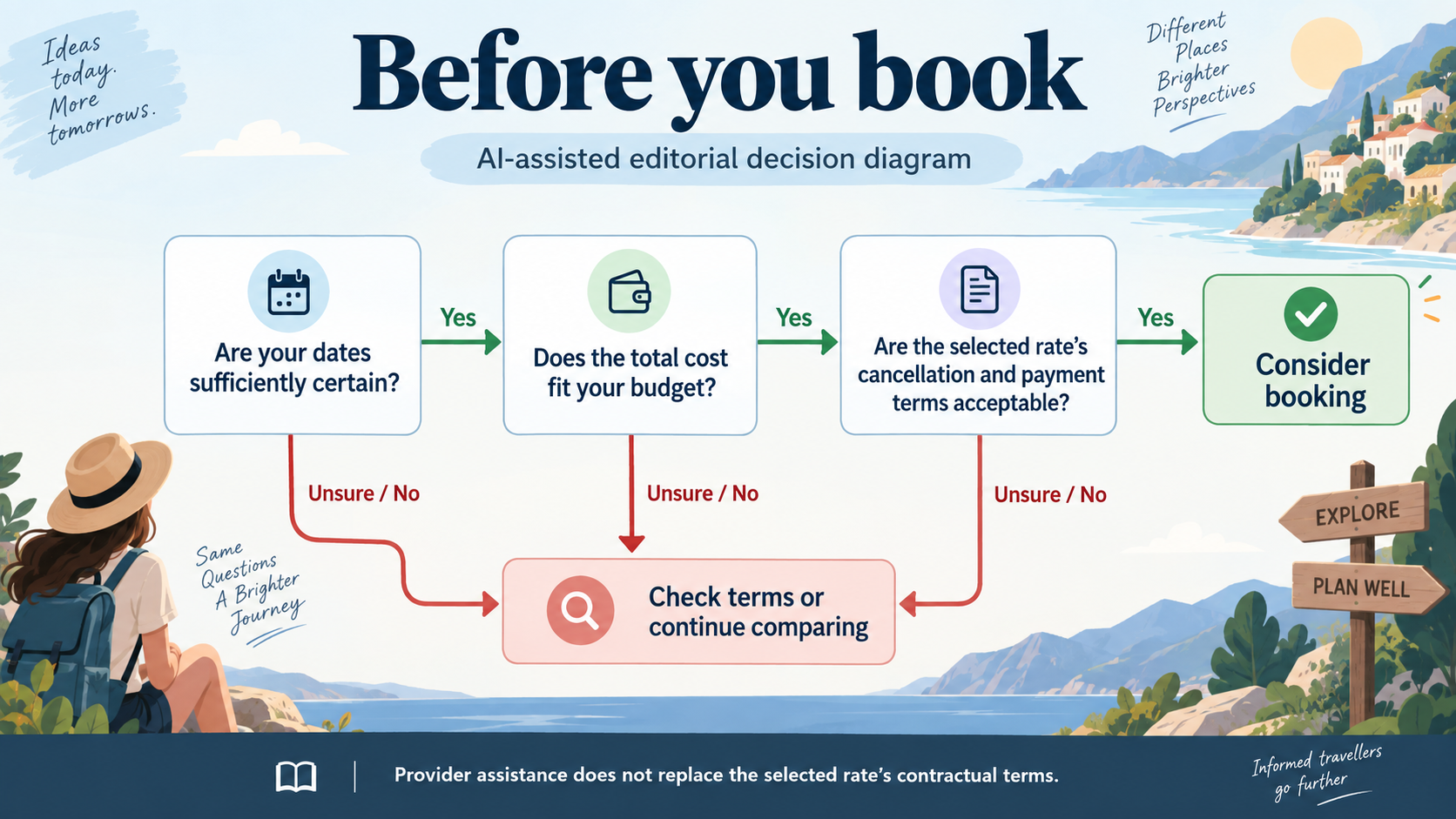 Use the information you have collected to make a decision you can explain without predicting tomorrow's price. Your aim is to find an acceptable reservation within your constraints.
Work through this decision guide for each shortlisted rate:
| Decision question | If the answer is yes | If the answer is no or unclear |
|---|---|---|
| Are the dates sufficiently certain, or do the stated change rights cover your uncertainty? | Check the whole-trip total. | Compare alternative dates or clarify the change conditions. |
| Does the complete total fit your budget? | Review cancellation and payment terms. | Reconsider suitable dates, properties or inclusions. |
| Are the cancellation and payment terms acceptable? | Consider booking after the final checks. | Resolve unclear terms or compare another rate. |
Provider assistance does not replace the selected rate's contractual terms. Include only confirmed conditions when deciding whether you can accept the consequences of a change.
If a suitable option passes these checks, booking can be a reasonable choice. It does not establish that you have found the lowest possible future price. If it fails, identify the specific reason before continuing your search: an incomplete total, unsuitable deadline or uncertain room arrangement needs a different response.
Give further comparisons a purpose. For example, check whether a nearby date removes a budget problem or whether another acceptable rate has a usable cancellation deadline. Choose a review point that fits your planning needs, without treating it as a proven cheap booking window.
Use a final booking checklist
Before completing the reservation, check the selected rate again rather than relying on notes from an earlier search. Work through these details on the final booking screen:
- Dates: arrival, departure and number of nights, including any arrival after midnight.
- Guests: the correct number of adults and children, with ages where requested.
- Room: room category, bed arrangement and occupancy details that matter to your group.
- Inclusions: meals and any other listed benefits you are relying on.
- Total: the payable amount, identified mandatory charges and anything payable separately at the property.
- Currency: the currency shown for each amount and any unclear conversion information.
- Payment: when payment is due and which amounts are collected at each stage.
- Cancellation and changes: deadlines, time zones, charges and the process for making a request.
Trip.com publishes round-the-clock customer support via chat or phone in its Customer Service Guarantee. Use the provider to resolve unclear current conditions for the exact room and rate before paying.
After booking, retain the confirmation and the conditions attached to the selected rate. Check that the confirmation matches your intended reservation, and keep any relevant clarification with it. If a detail is wrong or missing, contact the provider promptly.
[primary_cta]
Frequently Asked Questions
How far in advance should I book a hotel?
The supplied official sources do not establish an optimal number of days or weeks in advance. Begin comparing once you can define acceptable dates, a budget and essential room requirements. Consider booking when an available option meets those needs and its conditions are acceptable. If plans remain uncertain, check whether the specific rate's cancellation or amendment terms cover that uncertainty.
Is there a cheapest day of the week to book a hotel?
These sources do not establish a universally cheapest weekday for making a reservation. Keep the day you book separate from the dates you stay. For your own trip, compare nearby stay dates using complete quotes and consistent room requirements. Include transport changes and other unavoidable costs before deciding whether moving the stay offers better value.
Does free cancellation mean I can cancel at any time?
Do not interpret the label as permission to cancel at any time. Read the individual rate's deadline, time zone and conditions, and check what charge is stated after the cut-off. If the deadline or cancellation process is unclear, ask the provider before booking. Retain the conditions and any confirmation if you later submit a cancellation request.
Is pay later the same as free cancellation?
Treat payment timing and cancellation permission as separate checks. A payment label alone does not tell you what cancellation conditions apply. Establish when money is due, whether any earlier payment is required and what charges the rate specifies if you cancel. Ask the provider to clarify any unclear relationship between the payment schedule and cancellation terms.
What should I check if I find a lower price after booking?
Compare the replacement's dates, guests, room, inclusions, complete total and terms with your existing reservation. Check whether the replacement is actually available and whether cancelling the original would incur a charge. Clarify any payment or refund timing that affects your budget. Before cancelling, establish how you would secure the replacement; refer uncertainty about a booking-specific refund to the provider.
Related reading
- How to compare hotel deals without overlooking the total cost
- Best hotel booking websites: evidence-led choices for different trips
- Expedia vs Booking.com: which hotel booking platform fits your trip
- Expedia review: hotel booking strengths, limits and alternatives
Editorial information: About our editorial team · Read our editorial policy · Read our affiliate disclosure.