Start with the stay you actually need
Begin with a short description of your trip: your dates, who is travelling, what you plan to do and what you can spend on the whole stay. Add the facilities you could not comfortably manage without. This gives you a consistent basis for comparing accommodation.
Separate your requirements into essentials and preferences. An essential might be a confirmed bed arrangement, step-free access along a particular route or an arrival time the property can accommodate. A preference might be a particular view or being close to cafés. Decide which is which before an appealing photograph influences your shortlist.
Assess three dimensions separately: whether the room suits your party, whether the address supports your itinerary and whether guest feedback addresses your priorities. Avoid letting one attractive feature settle all three questions.
This guide provides an editorial comparison method, not a tested ranking of hotels or booking platforms. Trip.com’s official pages describe its accommodation network and customer support, but those descriptions do not establish the quality of an individual hotel. Use them to understand the platform’s stated role while checking the actual room offer separately. Trip.com About page, Trip.com service information.
Compare the exact room and its inclusions
AI-generated generic editorial illustration — not a retailer product photo and does not depict the reviewed product or service.
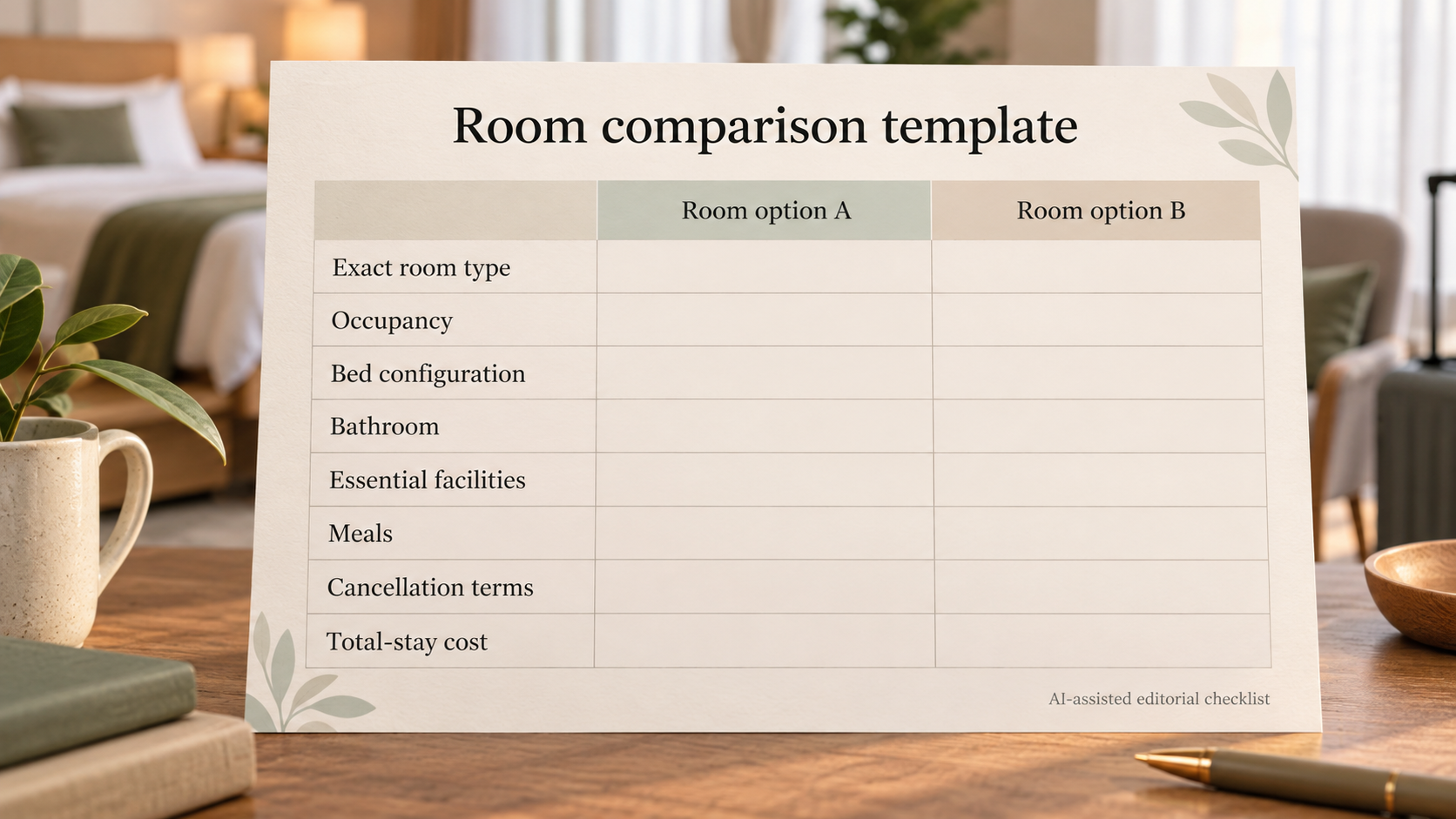 Compare the offer you would actually book, including its room category and rate conditions. Do not assume that a property name, similar photographs or a familiar room label establishes that two offers are equivalent. Treat equivalence as something to check field by field.
Start with occupancy and sleeping arrangements. Record how many adults and children the offer covers, the stated bed configuration and whether any extra sleeping space is confirmed. If a particular arrangement matters, ask whether it is part of the booked category or a request awaiting confirmation.
Next, examine the bathroom and essential facilities. Look for an explicit description of anything decisive, such as a private bathroom or the access features you need. Where wording is broad, write down the specific question it leaves unanswered. A general facility label is a prompt for clarification if your requirements are more precise.
Use this comparison template for two shortlisted offers. The empty cells are for details from each offer; enter “confirm” wherever information is missing.
| Comparison field | Room option A | Room option B |
|---|---|---|
| Exact room type and rate name | — | — |
| Occupancy for your party | — | — |
| Bed configuration | — | — |
| Bathroom arrangement | — | — |
| Essential facilities | — | — |
| Meals and who is covered | — | — |
| Cancellation terms and deadline | — | — |
| Total-stay cost and currency | — | — |
For meals, check which guests and dates are covered. For cancellation, record the stated deadline and time zone, any stated charge and where you found the conditions. Ask the provider about unclear wording.
Compare costs for identical dates and party sizes. Record the full-stay amount shown, what it includes and any separately stated charges. If something remains unclear, keep it visible as an unresolved cost rather than assuming it is included.
Judge location against your daily routes
Choose a location by working through your itinerary. Start with your arrival point, the places you expect to visit most often and your likely evening returns. For each shortlisted address, check those journeys using transport information for your intended travel dates and times.
Build a small route list: arrival to accommodation, accommodation to your main activity, and your final evening stop back to the property. Include the departure journey if an early start could affect your choice. Compare the practical steps involved, including changes, walking sections and the luggage you will carry.
Treat “central” as a description to investigate. Ask which part of the city matters for your plans. Likewise, examine what a nearby transport connection actually offers: the route you need, the relevant entrance and the service at your expected travel time.
For access needs, check the entire journey you intend to use, including the approach to the building and the route to your room. Ask specific questions about any step or transfer that could determine suitability.
Finally, consider your preferred surroundings. Use maps and relevant guest comments to identify questions about evening activity or noise, then seek clarification where necessary. Keep location convenience separate from room suitability: an appealing address should not erase an unresolved essential requirement.
Read guest reviews for relevant patterns
Before reading reviews, write down the questions you want them to help answer. You might be investigating night-time noise, the experience of arriving late or how guests describe the room category you are considering. This keeps your reading connected to your own stay.
Start with recent, detailed accounts, then compare them with older comments to see whether a concern recurs or appears isolated. Look for enough context to judge relevance: the room described, the circumstances of the stay and the specific experience reported. Where those details are absent, avoid filling in the gaps yourself.
Read positive and negative feedback against the same priorities. A guest’s enthusiasm for the surrounding nightlife may raise a question for someone seeking quiet evenings. A complaint about distance from a landmark may matter little if that landmark is outside your itinerary. Translate each observation into a question about your trip.
Keep a distinction between a guest report and a confirmed booking detail. Reviews can guide your enquiries, but do not use them as confirmation that your selected room includes a particular feature. Ask the property or booking provider to clarify that feature for the exact offer.
When an overall score and recent comments seem inconsistent, examine the substance of the comments before deciding. Is the issue relevant, specific and repeated? Does it concern your intended room or a different part of the property? Treat management replies as additional context, not independent verification that a problem has been resolved.
Finish with a short note for each property: relevant positive patterns, relevant concerns and questions still open. Avoid creating a numerical score that disguises uncertainty.
Understand what platform choice and support can add
A booking platform’s stated range and contact options are useful context when deciding where to search and whom to contact about a booking. Assess these separately from the accommodation itself.
Trip.com’s official About page describes an extensive hotel network and multilingual customer support. This is the company’s description of its reach and service provision; network size does not establish whether a particular room is suitable for you. Trip.com About page.
Its official service page states that customer support is available 24/7 through chat or phone. An advertised contact route may be useful when you need to raise a booking question, particularly outside your usual daytime hours. However, availability alone does not establish how quickly a particular enquiry will receive a response or what its outcome will be. Trip.com service information.
Before booking, identify how you would contact support and where you would find your booking reference. Keep those details with the offer conditions you intend to accept.
Use this as one part of your decision. These official descriptions support a bounded discussion of Trip.com’s stated services, rather than a cross-platform assessment or an endorsement of any hotel listed through it.
Recognise the limits of listings and service commitments
Keep three types of information distinct: what the offer states, what guests report and what the platform says about its service. Each answers different questions. Trip.com’s corporate and service pages do not verify the condition of your selected room, the suitability of its location for your itinerary or the accuracy of individual reviews. Trip.com About page, Trip.com service information.
The service wording also needs to be read with its conditions intact. Trip.com states that, if a stay has been confirmed but the property can no longer arrange check-in before you arrive, it will notify you immediately and work with the property to try to arrange a room of the same or a higher standard. This describes a stated assistance process in a particular situation. Trip.com service information.
Do not read that commitment to try to coordinate accommodation as an unconditional promise of a replacement, refund or successful resolution in every case. The supplied wording does not establish those outcomes. Consult the provider’s current, complete terms for the situation affecting your booking.
For payment, cancellation and changes, return to the conditions attached to the exact offer. If a general description and the offer details leave you uncertain, ask the provider to explain what applies before proceeding.
Record unanswered questions plainly. “Not confirmed” is a useful comparison entry: it makes clear which decisions still depend on information you do not yet have.
Build a shortlist and confirm the decisive details
AI-generated generic editorial illustration — not a retailer product photo and does not depict the reviewed product or service.
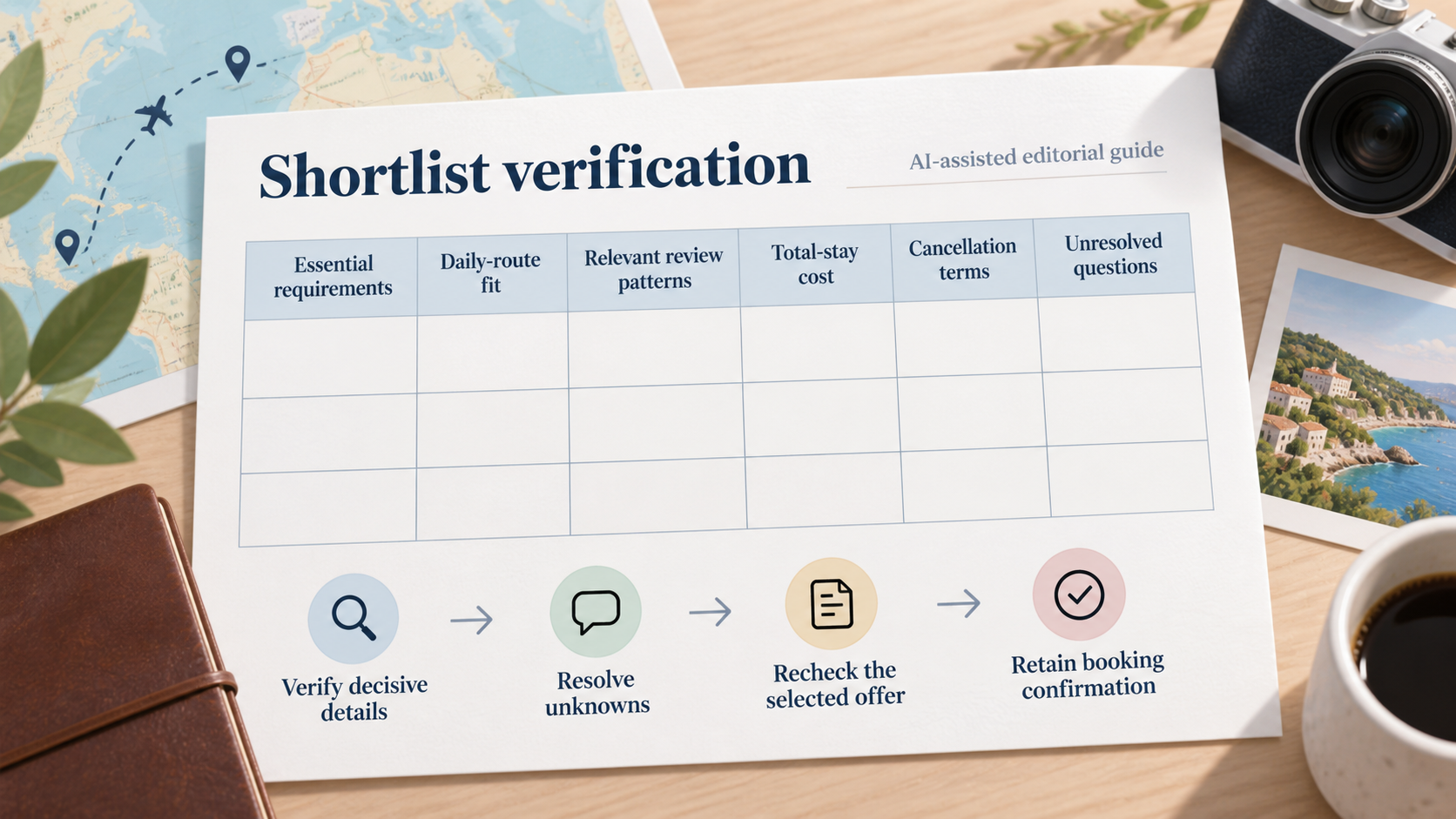 Reduce your options to a manageable shortlist, such as three offers that appear to meet your essentials. Summarise each using the same fields so that an attractive photograph or headline score does not dominate the decision.
Use this shortlist template alongside the more detailed room comparison. Fill it with your findings; it contains no property recommendations or calculated rankings.
| Offer | Essential requirements | Daily-route fit | Relevant review patterns | Total-stay cost | Cancellation terms | Unresolved questions | |---|---|---|---|---|---|---|---| | A | — | — | — | — | — | — | | B | — | — | — | — | — | — | | C | — | — | — | — | — | — |
For every essential, record whether it is stated in the offer, separately confirmed or still unknown. Keep guest-reported observations in the review column so they remain distinguishable from details supplied for your booking.
Then follow a final verification sequence:
- Verify decisive details. Check the room, occupancy, beds, bathroom and facilities that determine whether the stay works.
- Resolve unknowns. Send precise questions identifying the room category, dates and requirement. Retain the replies.
- Recheck the selected offer. Review dates, guest details, inclusions, full-stay cost, payment conditions and cancellation terms immediately before confirming.
- Retain the confirmation. Keep the booking reference, accepted conditions, relevant correspondence and support contact details together.
If an essential remains unresolved, keep the offer provisional. Choose on the basis of the trade-offs you understand and are comfortable accepting.
Ready to compare your options? Start with the exact room offer and work through the unanswered questions before booking.
Frequently Asked Questions
How can I tell whether two listings offer the same room?
Match the exact room category, occupancy, bed configuration, bathroom and stated facilities. Then compare the rate conditions, including meals and cancellation. Similar names or photographs should prompt a closer check rather than an assumption. If a decisive detail differs or is missing, ask the provider to confirm the offer you intend to book.
Should I choose a central hotel or one near a transport connection?
Compare both addresses against your actual routes, including arrival and evening returns. Check the transport services you would use at the relevant times. Prefer the option that supports your itinerary and access requirements while meeting your room needs and budget; treat “central” as one piece of context.
How should I weigh a high overall score against recent negative reviews?
Read the recent comments for specific, repeated issues relevant to your stay. Check whether they describe the room or circumstances you are considering. Use the overall score as a starting point, then turn material concerns into questions. Neither a score nor a guest account confirms your booking’s features.
What should I confirm if an essential room feature is unclear?
Ask a precise question that names the room category, your dates and the feature required. Request clarification on whether it is included and confirmed for that offer or remains a request. Retain the response and compare it with the final booking details before proceeding.
Does Trip.com's service support mean every booking problem will be resolved?
No universal outcome is established by the supplied service wording. Trip.com advertises 24/7 chat or phone support and describes efforts to help in specified circumstances. Check its current service terms and your exact booking conditions, and contact the provider about the particular issue. Trip.com service information.
Related reading
- When to book a hotel: comparing dates and flexible options
- How to compare hotel deals without overlooking the total cost
- Best hotel booking websites: evidence-led choices for different trips
- Expedia vs Booking.com: which hotel booking platform fits your trip
Editorial information: About our editorial team · Read our editorial policy · Read our affiliate disclosure.